
Generational Differences at Work.
Few topics generate as much discussion in leadership and talent conversations as generational differences. In assessment workshops, the question inevitably comes up: “How do personality assessments capture generational differences?” The answer, grounded in decades of research, is far less exciting than the stereotype.
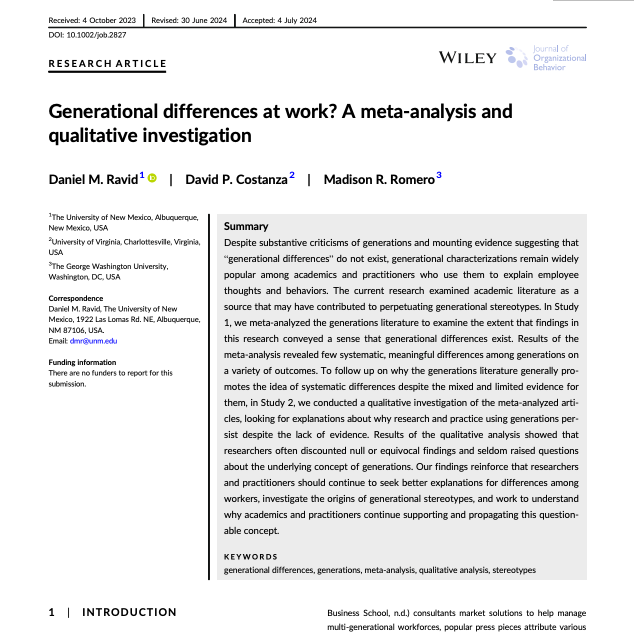
The paper, “Generational differences at work? A meta-analysis and qualitative investigation,” examines whether generations truly differ in meaningful ways at work. The conclusion is clear: despite their popularity, generational labels are a weak and often misleading lens for understanding employee behavior, motivation, or performance.
Generational frameworks persist because they are intuitive. Like horoscopes, they offer a simple way to make sense of complex human behavior and create social identity: “people like me” versus “people not like me.” What we often interpret as generational differences, however, might be more accurately explained by access to technology, career experience, or broader social and economic conditions. Not enduring differences in personality or work values.
The authors note that while business schools, consultants, and popular media continue to promote generational explanations, the empirical support for using generations in organizational decision-making is, at best, limited. In fact, a National Academies of Sciences report explicitly recommends against using generational categories in the workplace, characterizing them as stereotypes rather than scientifically grounded distinctions (National Academy of Sciences, 2020).
Beyond being unsupported by evidence, generational labels carry risk. Using them to shape HR policies or talent decisions can expose organizations to legal challenges under age discrimination laws. At the individual level, they can also undermine performance, signaling to employees that their capabilities, preferences, and potential have already been determined by a label rather than evidence.
The bottom line: the research finds little evidence that generations meaningfully differ in their work values. For organizations serious about performance, engagement, and fairness, the more effective path forward is focusing on data, context, and validated assessments.