
EXECUTIVE & LEADERSHIP COACHING
Coaching grounded in science, based on your specific context.
NDx coaching is built on a data-informed foundation to give leaders a precise picture of how they operate, where they’re most effective, and what targeted development looks like for their specific context.
WHO IT’S FOR
INDx Coaching is designed for leaders and organizations in which development needs to be both rigorous and aligned with role demands, not just personal growth goals.

The right fit if any of these apply.



A senior leader whose impact isn’t matching their potential
Strong technically, well-regarded, but something in their leadership approach is creating friction, limiting reach, or holding back the team around them.
A high-potential leader preparing for a step up in scope
The next role is bigger, more complex, or more visible, and the behaviors that worked previously may not serve them in the new context.
A newly hired or newly promoted leader in a critical transition
The first 90 days set the tone. A coaching engagement grounded in assessment data gives new leaders a clear picture of how they’re likely to show up and where to invest their attention early.
An organization that wants coaching tied to measurable outcomes
Past coaching investments felt valuable but were hard to evaluate. INDx builds progress reporting into every engagement so the sponsoring organization can track development alongside the leader.
INDx coaching engagements begin with a full Hogan assessment and 360 to give the coach and the leader a deeper understanding of how they’re experienced. Development priorities aren’t derived from intake conversations or self-report alone. They’re based on data, outcomes, and context.
Accountable to the Organization
Progress reporting, that does not compromise confidentiality, gives stakeholders a clear view of what’s being worked on and how it’s progressing.
WHY IT MATTERS
Good coaching changes behavior. Great coaching starts with understanding it.
The difference between coaching that produces lasting change and coaching that doesn’t usually comes down to one thing: whether the development is grounded in data.
Data-Based from the Start
Business Psychology, Not Just Conversation
INDx coaching conversations aren’t just reflective. They’re informed by an understanding of how personality, values, and derailers interact with role demands, team dynamics, and organizational expectations.
The majority of executive coaches work from what the leader brings to the engagement: their challenges, their observations, their sense of where they need to grow. INDx starts from a richer foundation to provide the leader with a greater sense of self-awareness regarding where they’re likely to thrive, where they’re likely to struggle under pressure, and how their values influence what motivates or drains them. The result is coaching moves faster, goes deeper, and produces development that holds.

FULL PROCESS & DELIVERABLES
Executive & Leadership Coaching One-Page Overview
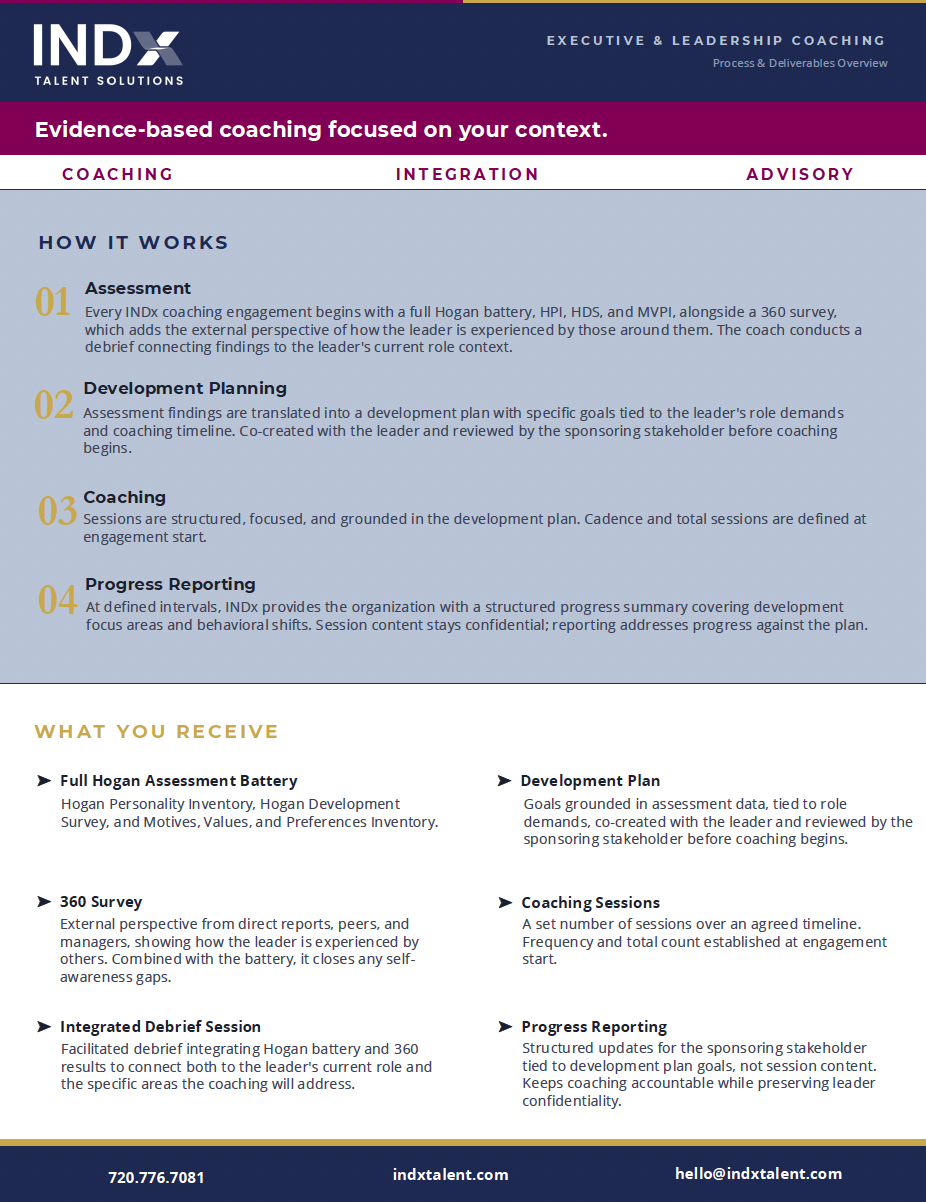
Every step, every deliverable, and what your organization receives, all in a single shareable document designed for the people making the decision.
HOW IT WORKS
Coaching
Sessions are structured and focused, and they connect behavioral patterns to real situations the leader is navigating. Cadence and the total number of sessions are agreed upon at the start of the engagement.
A rigorous foundation across coaching formats.
Development Planning
Assessment findings are translated into a development plan with specific goals tied to the leader’s role demands and timeline; co-created with the leader and presented to the stakeholder.

Assessment
INDx coaching engagements begin with a full Hogan battery, HPI, HDS, and MVPI, alongside a 360 survey. The coach conducts a debrief connecting the results to the leader’s context to identify the specific development areas the engagement will address.

At defined intervals, INDx provides the sponsoring organization with a structured progress summary covering development focus areas. Session content remains confidential; reporting focuses on progress against the plan.

Progress Reporting
COACHING FORMATS
The same methodology. Distinct contexts.
The scope, focus, and cadence are shaped by the leader’s context and what the engagement needs to accomplish.
Executive Coaching
1:1 coaching for senior leaders and executives whose development has a direct organizational impact. Engagements are typically 6-12 months, with monthly or bi-monthly sessions.
TYPICAL USE CASE
A high-performing executive who has plateaued, a senior leader navigating a significant transition, or an organization investing in the long-term development of a key leader.
New Leader Integration Coaching
Focused coaching for leaders in their first 90 - 120 days of a new role. Whether newly hired or newly promoted, coaching is focused on accelerating alignment and effectiveness.
TYPICAL USE CASE
A newly placed leader, a promoted leader entering an expanded role, or any senior hire where the first 90 days are particularly high-stakes.
Leadership Coaching
Structured coaching for leaders and high-potentials is being developed to expand their scope. Same Hogan foundation, same development-plan approach, calibrated to the leader’s context.
TYPICAL USE CASE
A high-potential leader on a succession track, a manager stepping into their next role, or a leader in a formal development program.
Advisory Coaching
An ongoing advisory relationship for C-suite leaders. These engagements are less structured than a coaching engagement and more responsive to real-time challenges. Rather than a defined session cadence and development plan, the Advisory Coaching format gives senior leaders retained access. Grounded in Hogan assessment, but designed to flex with what the leader needs in the moment; a critical decision, a board dynamic, a team challenge, rather than following a predetermined program.
TYPICAL USE CASE
A C-suite leader who wants a coach in their corner on an ongoing basis, not to follow a development program, but to have a trusted, behaviorally-informed outside perspective when the situation calls for it.
— FAQ
Questions we hear most often.
If you don't see your question here, bring it to the consultation. We are happy to talk through any aspect of the engagement before you get started.
-
In a standard coaching engagement, development priorities are largely self-defined; the leader brings their challenges and the coach helps them work through them. It’s limited by the leader’s own self-awareness.
INDx coaching starts with Hogan data, which gives both the coach and the leader a more complete and objective picture to work from. The result is development that’s more targeted, progresses faster, and holds up under pressure.
-
Progress reports address development plan goals. Specifically, whether the leader is demonstrating the shifts the coaching is focused on, and what adjustments to the plan are being made.
They do not include the content of coaching conversations, specific disclosures the leader has made, or assessments of the leader’s personal circumstances.
Leaders are aware of the reporting framework before the engagement begins, so there are no surprises about what gets shared.
-
Yes, if the leader has recent Hogan results (typically from 18-24 months ago), those can serve as the foundation for the coaching engagement without a full reassessment. INDx will review the existing reports, conduct a contextualizing debrief, and proceed from there.
If the leader’s results are older, INDx will advise on next steps.
-
Both. Coaching frequently follows other INDx engagements where the development priorities have already been identified.
We also offer coaching as a standalone engagement for organizations that want to invest in a specific leader’s development independent of a broader talent initiative.
LET’S START A CONVERSATION
Ready to invest in development that produces lasting change?
A 30-minute consultation with an INDx Talent senior practitioner. No pitch, no obligation. Just a focused conversation about the leader, the context, and what a well-scoped coaching engagement would look like.